


Spiraling Images
I had this inspiration in class today – when looking at a converging (tapering) spiral, we can see it is composed of many layers. I believe that any image/object can be ‘framed’ this way. Each slice of the spiral is unique, but is an important part to the ‘allness’ of the spiral in more than one way; it contributes structural support to the structure, as well as provides a complete image when viewed from the top. After reading “spirals” on Wikipedia, I learned that actually I am using the incorrect terminology mathematically:
“In mathematics, a spiral is a curve which emanates from a central point, getting progressively farther away as it revolves around the point. The concise mathematical definition is "The locus of a point moving at constant speed whose distance from a fixed point increases at a specific rate."
A "spiral" and a "helix" are two terms that are easily confused, but represent different objects.
A spiral is typically a planar curve (that is, flat), like the groove on a record or the arms of a spiral galaxy. A helix, on the other hand, is a three-dimensional coil that runs along the surface of a cylinder, like a screw. There are many instances where in colloquial usage spiral is used as a synonym for helix, notably spiral staircase and spiral binding of books. Mathematically this is incorrect but the terms are increasing in common usage.
A cross between a spiral and a helix is known as a conic helix. An example of a conic helix is the spring used to hold and make contact with the negative terminals of AA or AAA batteries in remote controls.”
I also found a great website dealing with spirals, http://spiralzoom.com//.
I hope to base my final project off this concept of a conic helix. When we view something, particular in nature (I have a particular attraction to the natural elements), we see slices of the helix. We cannot perceive the entirety of the image due to our physical constraints from being human. We can only see a small segment of the electromagnetic spectrum, and can only hear a small relatively small region of the auditory spectrum. In fact, we can only see about 300 nm (waves 400-700 nm in wavelength), which is an extremely small portion of the entire spectrum as you can see on the following figure. With our hearing limitations, we can only hear sound waves with frequencies from about 20 Hz (waves per second) to about 20,000 Hz). See the following figure for more details.

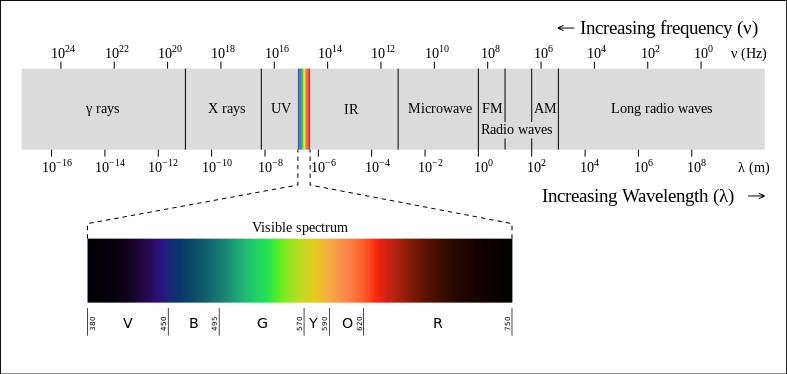
Much remains to be seen/found/uncovered in the other spectrums. For a complete framing of an object, there needs to be an examination in the other portions of helix, primarily portions that are by human means, impossible. To have a complete understanding/framing of an object, we must analyze a culmination of images, which individually examine the object in unique portions of the spectrum and not only our visible spectrum. After assembling these images, we may be able to see a more complete helix that can properly represent the object. We can superimpose the images on top of each other (similar to the construction of a helix) and see what superstructures arise. We may also be able to analyze similarities in the different parts of the spectrums.
I propose the following:
An examination of natural living objects (i.e. plants) in the different parts of the electromagnetic spectrum as well as different imaging techniques we currently use. Technologies, which come to mind immediately, include MRI, ultrasounds, x-ray, infrared, and CT scans. Obviously not limiting the project to these methodologies, they would provide a solid foundation for such an analysis. We could also use scale to examine symmetry in the structures. For example, I envision taking a panoramic picture of a forest, and then zooming in gradually to examine the more intricate structures presented by individual trees and plants and eventually leaves. We could further magnify this to examine cell structure. Furthermore, with the MRI, we could image the water molecules in the actual leaf. This is just an example.
As for the audio component, Professor Moss and I briefly spoke about the possibility of getting our hands on a contact microphone in which we could be maybe pick up endogenous vibrations of materials, which we could then amplify and present as well.
Such an examination would be artistically appealing, and scientifically revealing.
I would appreciate your thoughts/feedback on the matter.


